
AISI / EN 1.4845310S Stainless Plate & Coil Sheet
310S grade stainless steel, produced for furnace, heat-treatment, and combustion systems requiring high temperature resistance, is not carried by most suppliers in Türkiye — we keep it in stock and provide same-day quotes.
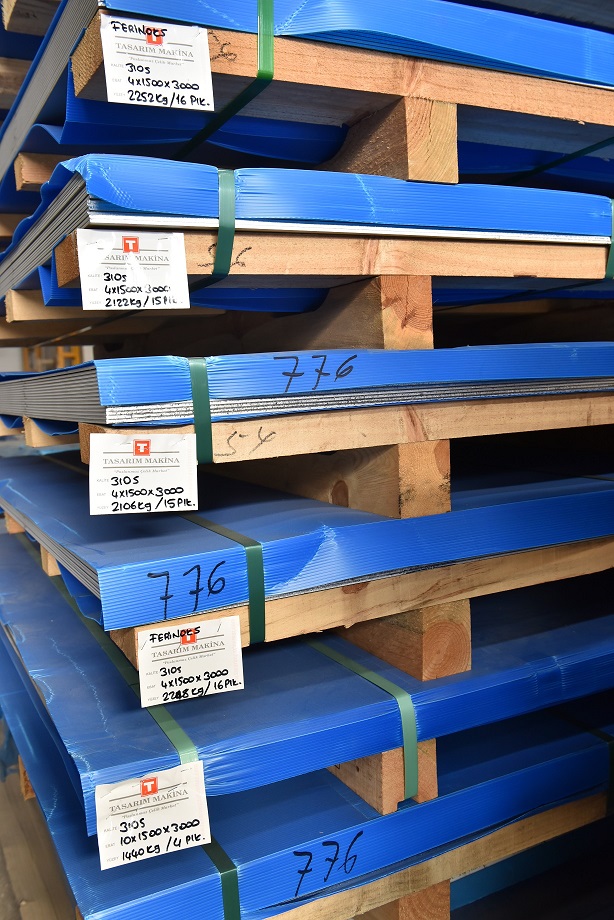 310S PLATE — STOCK
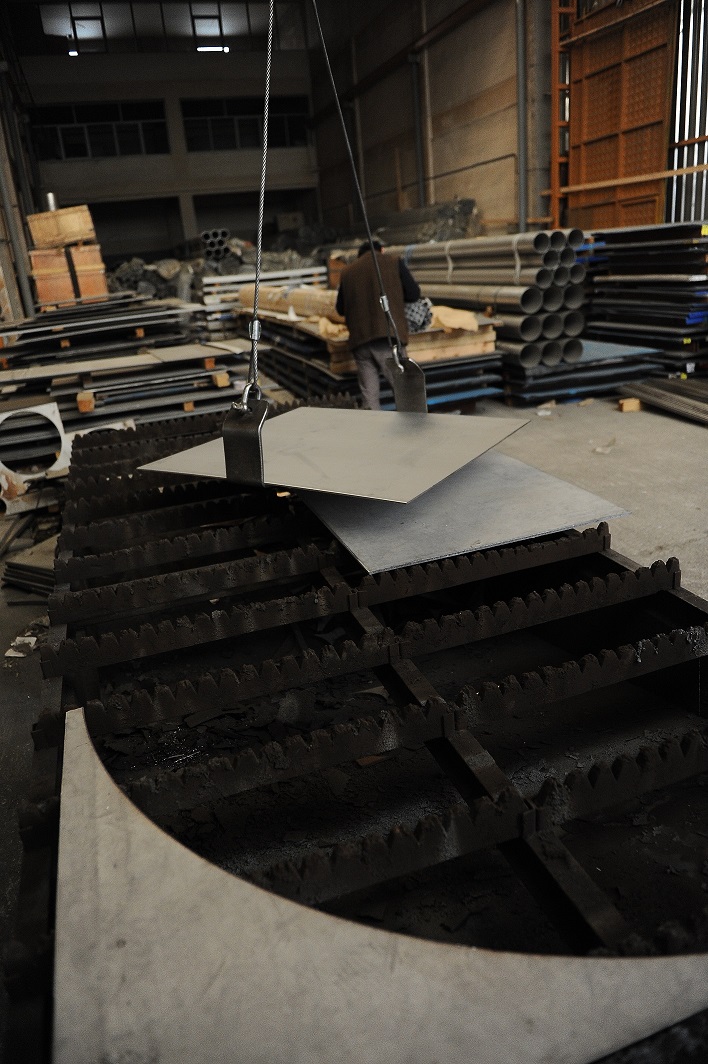 HAND PLASMA CUTTING
Preferred for systems operating under high heat
At temperatures where standard 304 and 316 grades fail, 310S's high chromium-nickel ratio provides oxidation and carburization resistance.
Furnace Equipment
Internal components, carrier racks, burner parts.
Exhaust Systems
High temperature gas lines, flues.
Heat Exchangers
High temperature transfer components.
Petrochemical
Reactor and pipeline components.
How does 310S differ from other grades?
| Grade | Max. Temp. | Cr / Ni | Stock |
|---|---|---|---|
| 310S | ~1150°C | 25/20 | Featured |
| 310-314 | ~1200°C | 25/20 | In Stock |
| 309 | ~950°C | 23/13 | In Stock |
| 321 | ~850°C | 18/10 | In Stock |
| 316L | ~400°C | 17/11 | In Stock |
| 304 | ~400°C | 18/8 | In Stock |
Why does it hold up at high temperature?
The high-temperature performance of 310S comes from two elements working together.
Chromium
Builds a dense, adherent chromium-oxide layer at the surface. That layer separates the rest of the material from oxygen; the more stable it is, the longer the material lasts.
Nickel
Keeps the structure beneath that layer austenitic and tough, reducing the risk of phase change and embrittlement at high temperature.
Neither one produces heat resistance on its own. Grade 304 sits around 18% chromium and 8% nickel, and starts scaling far earlier in the same environment.
Sulphur-bearing atmospheres behave differently, where high nickel becomes the limiting factor. If your process involves sulphurous gas, let us work through the grade choice with you; we have an alternative.
EN 1.4845 composition
| Element | % by mass |
|---|---|
| C | ≤ 0,08 |
| Si | ≤ 0,75 |
| Mn | ≤ 2,00 |
| P | ≤ 0,035 |
| S | ≤ 0,015 |
| Cr | 24,00 - 26,00 |
| Ni | 19,00 - 21,00 |
What the “S” means
310S is the low-carbon version of 310. Carbon can reach 0.25% in 310, while 310S is capped at 0.08%.
Lower carbon delays chromium-carbide precipitation at the grain boundaries, so the material stays more stable after welding and through long spells of hot service. That is why 310S is the one chosen for welded fabrication.
At room temperature
| EN min. | Typical | |
|---|---|---|
| Proof (Rp0.2) | 210 MPa | 240 MPa |
| Tensile (Rm) | 500 MPa | 600 MPa |
| Elongation (A5) | %35 | %50 |
A 35% minimum elongation shows the material takes cold forming well. Its austenitic structure lets it bend and form without cracking.
Design values
| Density | 7,8 kg/dm³ |
| Modulus of elasticity | 158 GPa |
| Thermal expansion (20-400°C) | 18,4 × 10⁻⁶ /°C |
| Thermal conductivity | 19,8 W/m·°C |
| Specific heat | 582 J/kg·°C |
| Magnetic | Non-magnetic |
The thermal expansion coefficient is roughly 1.5 times that of carbon steel. Allow for it when detailing a construction that runs hot.
What sizes do we hold?
| Thickness | Surface | Form |
|---|---|---|
| 0,40 - 3 mm | 2B | Sheet |
| 3 - 50 mm | No.1 | Plate |
We hold 310S sheet and plate in stock from 0.40 mm up to 50 mm. Surface finish follows from thickness: thin sections are cold rolled and come with a 2B finish, while 3 mm and above is usually hot rolled No.1. Since 310S is chosen for heat rather than appearance, thickness and temperature profile are what drive the selection.
Coil is available in a narrower range than sheet. Tell us what you need and we will check availability with you. Stock moves, so ask us for the current position.
Where is 310S sheet used?
Furnace fabrication
Furnace casings, inner shell linings, door and seal faces.
Heat treatment plants
Part baskets, carrier fixtures, grids and rack systems.
Flues and ducting
Lines carrying flue gas at high temperature.
Boilers and burners
Sheet components working close to the flame zone.
Cement and lime
Clinker cooler plates and surfaces carrying hot dust.
Glass industry
Carrier and mould surfaces in contact with hot glass.
Frequently asked questions
What is the difference between 310 and 310S?
Carbon content. Carbon can reach 0.25% in 310 but is capped at 0.08% in 310S. Lower carbon delays chromium-carbide precipitation after welding and through long hot service, which is why 310S is preferred for welded work.
How hot can 310S run?
The comparison table above shows where 310S sits against the other grades. Send us the temperature profile of your application and we will settle on the right grade together.
Can 310S be welded?
Yes. Its low carbon content makes post-weld carbide precipitation less of a risk than with 310. Filler metal is normally an electrode of 310 composition.
Is 310S magnetic?
No. It is austenitic and non-magnetic in the annealed condition. Heavy cold forming can leave slight surface magnetism.
How do I choose between 310S and 316L?
They solve two different problems. 316L contains molybdenum and is chosen for corrosion resistance; 310S is chosen for temperature. If your process runs hot, look at 310S; if it is chemically aggressive, look at 316L.
Are 1.4845 and 310S the same thing?
Yes. 1.4845 is the European (EN) number and 310S is the American (AISI) equivalent. The ASTM designation is S31008.